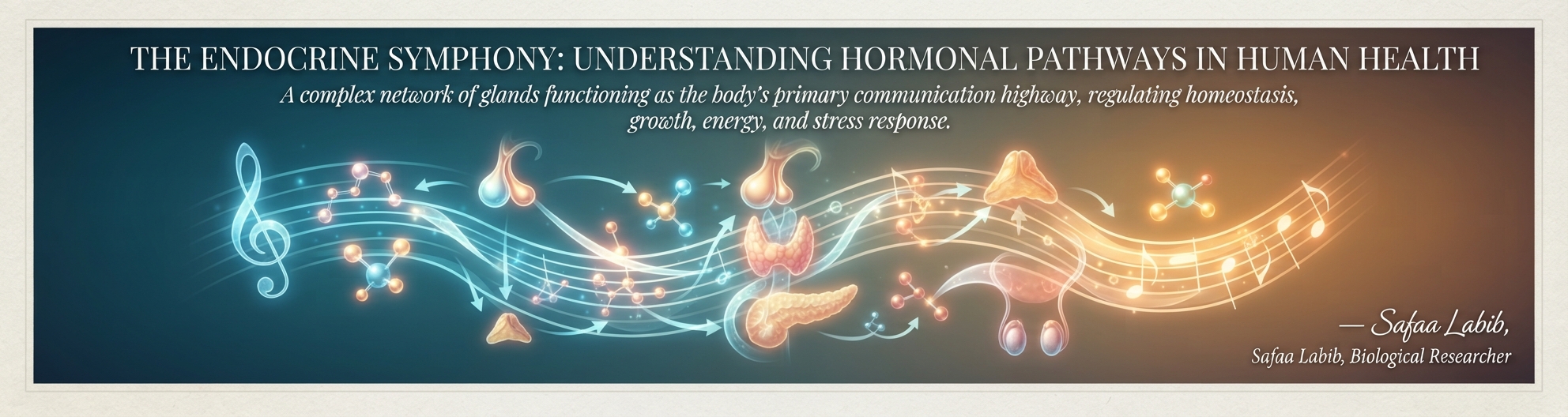
The Endocrine Symphony: Decoding the Human Body’s Chemical Messaging Network
...
Have you ever paused to consider what truly dictates your daily fluctuations in mood, vitality, and focus? While we frequently attribute our drive to sheer willpower, the actual command center resides within the endocrine system. This intricate architecture of glands functions as the organism's premier internal communication channel, dispatching vital molecular messengers known as hormones to every target tissue.
Furthermore, these biochemical signals transcend basic growth regulation; they actively preserve homeostasis, the critical internal equilibrium essential for human viability. Specifically, hormones govern energy metabolism, modulate stress reactions, and shape physiological variations across sexes. Consequently, mastering these biochemical pathways is not merely an academic pursuit—it is an indispensable prerequisite for optimizing long-term wellness and physical capability.
The Metabolic Engines: Insulin and Thyroid Hormones
Sustaining a healthy biological machine requires a continuous, tightly regulated energy supply. Two primary regulatory systems govern this dynamic balance: the pancreas and the thyroid gland.
Insulin: The Cellular Gatekeeper The pancreas synthesizes insulin, a crucial peptide hormone responsible for maintaining glycaemic control. Metaphorically, insulin acts as a molecular key. Following nutrient ingestion, glucose floods the bloodstream but cannot cross cellular membranes independently. Insulin binds to receptors, unlocking the cell to facilitate glucose entry for cellular respiration. Without this key, internal starvation occurs despite a nutrient-rich blood supply.
Thyroxine (T4): The Metabolic Governor Concurrently, the thyroid gland secretes thyroxine (T4), which functions as the body's internal metabolic thermostat. Put simply, this compound determines the baseline operational speed of our cellular machinery. Excess thyroxine accelerates the metabolic rate, whereas a deficit decelerates energy production, manifesting as lethargy and weight accumulation.
When these dual mechanisms operate in synchrony, they guarantee an uninterrupted fuel supply to every organ system.
The Neuroendocrine Stress Axis: Cortisol and Adrenaline
In contemporary environments, modern stressors—ranging from professional deadlines to social friction—are frequently interpreted by the brain as physical threats. In response, the adrenal glands rapidly discharge two major stress hormones: adrenaline and cortisol.
Adrenaline: The Acute Catalyst Adrenaline drives immediate physiological adaptation. Functioning as an acute emergency alarm, it instantaneously accelerates heart rate and shunts blood flow toward skeletal muscle groups. This evolutionary surge prepares the organism for rapid action, commonly recognized as the "fight-or-flight" paradigm.
Cortisol: The Sustained Administrator While adrenaline handles immediate crises, cortisol coordinates prolonged stress adaptation. Imagine cortisol as an internal resource allocator; it elevates circulating glucose to maintain cognitive vigilance while suppressing non-critical functions—such as digestive processes—to conserve energy. However, prolonged elevation via chronic stress leads to systemic exhaustion and immune suppression.
Sexual Dimorphism in Stress: The Influence of Oxytocin
Interestingly, physiological literature reveals distinct stress-processing paradigms between sexes, heavily modulated by the neuropeptide oxytocin.
In Males: Stress activation predominantly triggers a classical "fight-or-flight" reaction, steered primarily by cortisol and adrenaline.
In Females: Higher baseline and reactive oxytocin levels frequently foster a "tend-and-befriend" behavioral response, encouraging social affiliation and collective support to mitigate stress impacts.
Thus, while the baseline alarm triggers similarly, recovery and adaptation pathways exhibit notable sexual dimorphism.
Systemic Impact of Sex Steroids: Testosterone and Estrogen
Testosterone: A Systemic Biological Catalyst Beyond its classical association with secondary sexual traits, testosterone acts as an expansive biological catalyst. It plays a pivotal role in preserving musculoskeletal architecture and cardiovascular integrity. Functioning as a maintenance agent within male physiology, it stimulates erythropoiesis (red blood cell production) to optimize tissue oxygenation. Furthermore, neurobiological data links optimal testosterone levels to enhanced spatial cognition and focus.
Estrogen: The Neuro-Vascular Guardian Within female physiology, estrogen (predominantly estradiol) serves as a sophisticated protective shield for critical organ systems. Its influence extends far beyond reproduction, governing vascular elasticity, bone mineral density, and neural modulation. Estrogen directly influences neurotransmitter synthesis, such as serotonin, thereby anchoring emotional balance and stress resilience.
Progesterone: The Neural Stabilizer Acting synergistically with estrogen, progesterone functions as an internal neurological stabilizer. It exhibits neuroprotective properties that facilitate neural recovery from stress and promote restorative sleep architecture.
Environmental Disruptors and Circadian Alignment
Despite the elegance of the endocrine network, contemporary environmental exposures frequently compromise these chemical pathways. Endocrine-Disrupting Chemicals (EDCs)—synthetic compounds found in plastics and industrial agents—can mimic natural hormones, occupying cellular receptors and derailing vital biological instructions.
Furthermore, circadian biology dictates that timing heavily influences hormonal output. Exposure to artificial blue light during nocturnal hours misleads the suprachiasmatic nucleus (the master biological clock), disrupting melatonin synthesis and metabolic regulation. Aligning daily lifestyle choices with natural biological rhythms remains vital for peak endocrine efficiency.
References
Guyton, A. C., & Hall, J. E. (2020). Textbook of Medical Physiology (14th ed.). Elsevier.
The Endocrine Society. (2023). Scientific Statement on Endocrine-Disrupting Chemicals.
Nature Reviews Endocrinology. (2022). The Circadian Clock and Metabolic Health.
Journal of Clinical Endocrinology & Metabolism. (2024). Hormonal Dimorphism: Understanding Sex Differences in Physiological Health.
Frontiers in Neuroendocrinology. (2021). Neuroprotective Roles of Steroid Hormones.
Support My Research & Stay Connected
If you found this biological deep dive valuable, I invite you to join my growing community of science-driven readers. My work is dedicated to exploring the intersection of neurobiology, psychoanalysis, and physical health to help you reclaim your Biological Sovereignty.
Subscribe to My Substack: Join the “Biological Sovereignty” newsletter for exclusive research updates, in-depth biological protocols, and nuanced insights delivered directly to your inbox. 👉 Join the Community on Substack
Support My Independent Work: If you’d like to fuel my research and help me create more high-quality, evidence-based content, consider supporting me. You can join my paid tiers on 👉 Patreon,
Connect Professionally: For professional networking, updates on my academic research, and industry discussions, let’s connect on 👉 LinkedIn
Explore More: You can find a collection of my published work and curated stories here:
👉 Safaa Labib on Digitalmehmet
Thank you for being part of this journey toward mastering your internal ecosystem.
Digitale Signaturen des Artikels
Was sind die digitalen Signaturen und wie prüfe ich die?Inhalts-Signatur:
427ba0cc97498d1b8f68741137bb7eb6MGYCMQCdgzcC8XSsp0mmAKf2f+qIpBsPqCoCi4zpPVumpEB+2SotOqksJB+Up8JX2ay9g4QCMQC8WJcMewh6GP2tXRVEqZBDmGJYrQvNrAwI6M8QdXdJz61/+9N/qNgN/GIppePl7QE=
Content Nation Signatur
MGQCMBDxVmgrKsi8v9o5T15VyPRH2EmY2EhsSL+07+s7coBrsR0EQH7b6AhChHtOzdp6sgIwZqT9sejs7kEIVvwpO/Yu+2DaeUKnINLuZgHSZyiW/OoVWehlxP+lgIYAZW0zAx5I
Mehr Signatur-Informationen
Inhalts-Signatur:
Profil public key (427ba0cc97498d1b8f68741137bb7eb6)