Why Your Body Fights a Shadow: The Neurobiology of Somatic Phobia
...
How the Amygdala’s “Thalamic Bypass” Converts a Visual Distortion into a Full-Scale Physiological Siege.
The Ghost in the Machine: When Physiology Preempts Logic
Picture yourself walking down a dimly lit corridor at night. Out of your peripheral vision, a long, sinuous form catches your eye on the floor. In a fraction of a second, your breath locks, your muscles tense, and an icy jolt of adrenaline rushes through your extremities. Your central nervous system has unilaterally declared a code red.
Moments later, your conscious awareness catches up: it is merely a garden hose left behind by the doorway.
For individuals contending with clinical phobias, however, that subsequent wave of cognitive relief frequently fails to materialize. Even when it does, the soma remains marooned in a state of hyper-arousal long after executive function has certified the absence of peril. This phenomenon is known as Somatic Phobia.
Mainstream culture often trivializes phobias as eccentric psychological quirks—irrational fixations that can simply be reasoned away. Yet, from a neurobiological vantage point, a phobia is far more than a cognitive aberration; it is a total somatic mobilization. The body wages war against an illusory shadow with the exact metabolic ferocity it would deploy against an apex predator. To comprehend why our biology elects such an energetically expensive response to a benign stimulus, we must explore the archaic architecture of the human brain.
The Thalamic Shortcut: The Neural Expressway to Panic
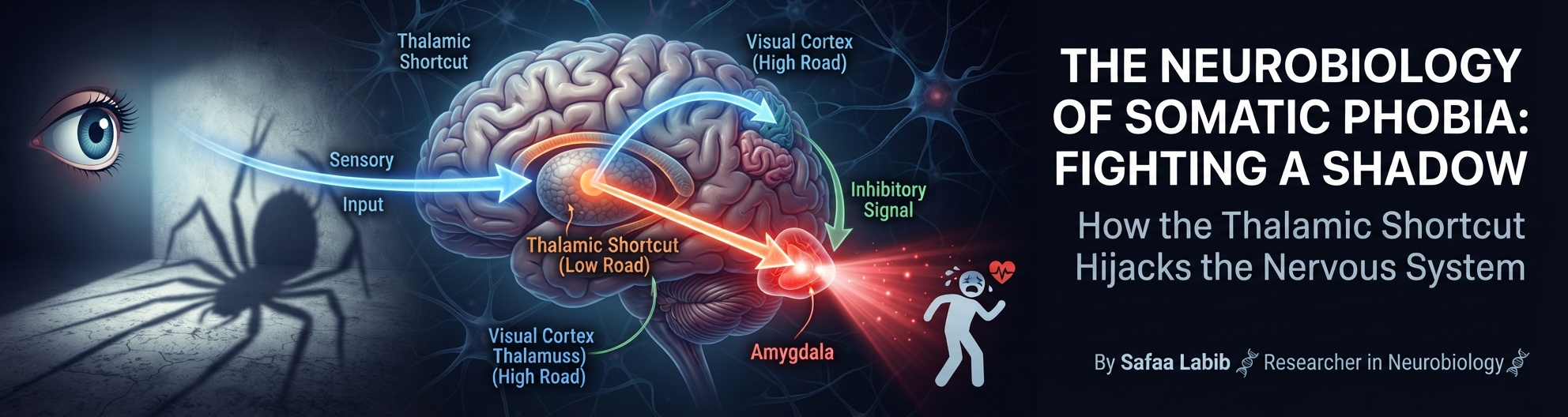
At the epicentre of the phobic reaction sits an evolutionary mechanism termed the "Thalamic Shortcut" or the "Low Road" of affective processing. Pioneered by neuroscientist Joseph LeDoux, this paradigm explains why human physiology routinely reacts to danger long before the conscious mind can process what is occurring.
When sensory data—such as the silhouette of an arachnid or the click of an elevator latch—enters the nervous system, it first registers in the Thalamus, the brain’s primary relay hub. Within a balanced neural architecture, the Thalamus routes this data toward the Visual Cortex (the "High Road"), where cortical networks methodically evaluate the object, confirm its harmlessness, and dispatch an inhibitory stand-down directive.
Within a phobic brain, however, the Thalamus exploits a rapid-fire neurological detour:
The Velocity Vector: This low-road circuit operates nearly twice as fast as cortical processing. By the time your Prefrontal Cortex begins mapping the object’s geometry, the Amygdala has already initiated a full-scale fight-or-flight cascade.
The Evolutionary Imperative: This architecture was optimized for ancestral survival, where misidentifying a vine as a snake carried zero survival cost, while misidentifying a snake as a vine proved fatal. In contemporary environments, however, this shortcut backfires, hijacking somatic resources before logic can intervene.
The Endocrine Cascade: A Biochemical Storm in Milliseconds
Once the Amygdala sounds the alarm via the thalamic route, it sparks rapid communication with the Hypothalamus, initiating the Hypothalamic-Pituitary-Adrenal (HPA) axis. Within milliseconds, systemic biochemistry undergoes a profound shift:
The Catecholamine Surge: The adrenal medulla floods circulation with epinephrine and norepinephrine. Pupils dilate to maximize light capture, and cardiac output surges to perfuse skeletal muscles with oxygenated blood, priming the body for an explosive sprint that never arrives.
The Glucocorticoid Anchor: Following the initial catecholaminergic wave, the adrenal cortex releases cortisol. This endurance hormone down-regulates non-essential functions like digestion and immune surveillance, explaining the visceral "gut knot" characteristic of phobic encounters.
Metabolic Toll: This biochemical orchestration demands immense cellular energy, accounting for the profound exhaustion that follows an acute phobic episode.
Genetic Echoes: Are Phobias an Ancestral Inheritance?
A central enigma in behavioral neurobiology is why modern humans rarely develop phobias toward contemporary hazards like electrical grids or automobiles, yet millions remain crippled by heights, enclosed spaces, or venomous insects. The answer lies in Biological Preparedness.
Evolution has pre-calibrated our neural circuitry to prioritize hazards that threatened our forebears across millennia. We are descendants of hyper-vigilant ancestors who reacted instantly to ambiguous shadows; those devoid of this caution rarely survived to transmit their genetic lineage. Emerging epigenetics suggests that severe fear conditioning can leave enduring molecular signatures on our DNA, functioning as intergenerational biological warning labels.
Neuroplasticity and the Reinforcement Loop
Phobias are dynamic constructs governed by neuroplasticity. Every encounter with a feared stimulus reinforces Long-Term Potentiation (LTP). Each time the Amygdala triggers a somatic crisis, it deepens the neural canyon. Consequently, future exposures route signals through this established pathway with increasing velocity, locking the individual inside an entrenched feedback loop while the Hippocampus struggles to supply accurate contextual updates.
Rewiring the Circuitry: The Biological Pathway to Recovery
Fortunately, neuroplasticity operates bi-directionally. Extinction learning—the cellular foundation of exposure therapy—gradually compels the Prefrontal Cortex to project inhibitory signals back onto the Amygdala, carving out competing safety circuits. Concurrently, deliberate stimulation of the Vagus Nerve through controlled, diaphragmatic breathing serves as a physiological circuit-breaker, shifting systemic regulation from sympathetic dominance back to parasympathetic equilibrium.
Conclusion
Overcoming a phobia is not an exercise in sheer willpower; it is an exercise in biological diplomacy. By recognizing that our physical form operates as an overzealous guardian running an ancient survival program, we can leverage the brain’s inherent plasticity to teach our nervous systems a new lexicon: safety in the presence of shadows.
Support My Research & Stay Connected
If you found this biological deep dive valuable, I invite you to join my growing community of science-driven readers. My work is dedicated to exploring the intersection of neurobiology, psychoanalysis, and physical health to help you reclaim your Biological Sovereignty.
Subscribe to My Substack: Join the “Biological Sovereignty” newsletter for exclusive research updates, in-depth biological protocols, and nuanced insights delivered directly to your inbox. 👉 Join the Community on Substack
Support My Independent Work: If you’d like to fuel my research and help me create more high-quality, evidence-based content, consider supporting me. You can join my paid tiers on 👉 Patreon,
Connect Professionally: For professional networking, updates on my academic research, and industry discussions, let’s connect on 👉 LinkedIn
Explore More: You can find a collection of my published work and curated stories here: 👉 Safaa Labib on Digitalmehmet
Thank you for being part of this journey toward mastering your internal ecosystem.
Digital signatures of this article
What are digital signatures and how do I verify them?Content signature:
427ba0cc97498d1b8f68741137bb7eb6MGYCMQCA+SBfeTiAPU4LNvSkvIVCL8EC8NCHnNksxEOdOR3eRC8GCa1w9r6iM0bdoPHdSvwCMQC7kfIeDj8jpdRkzSpjzAsoJSlI7Ox7WWMugLxPMIUv0cbUWgscx7Suo14ERvBnFzA=
Content Nation Signature
MGUCMDHKhqwV059JimPPpjgTlflmEQv4qbzFDoMLzy2GJoYfq5poV4OsrTT4mLH/Vdk2vQIxAJ2e+hANEGO+UlHkm/7TwGS4y+PSLTC3EyD8IVgQ1+8LAmannoIIA5KIc0FQW/U7Fg==
More signature information
Content signature:
Profile public key (427ba0cc97498d1b8f68741137bb7eb6)