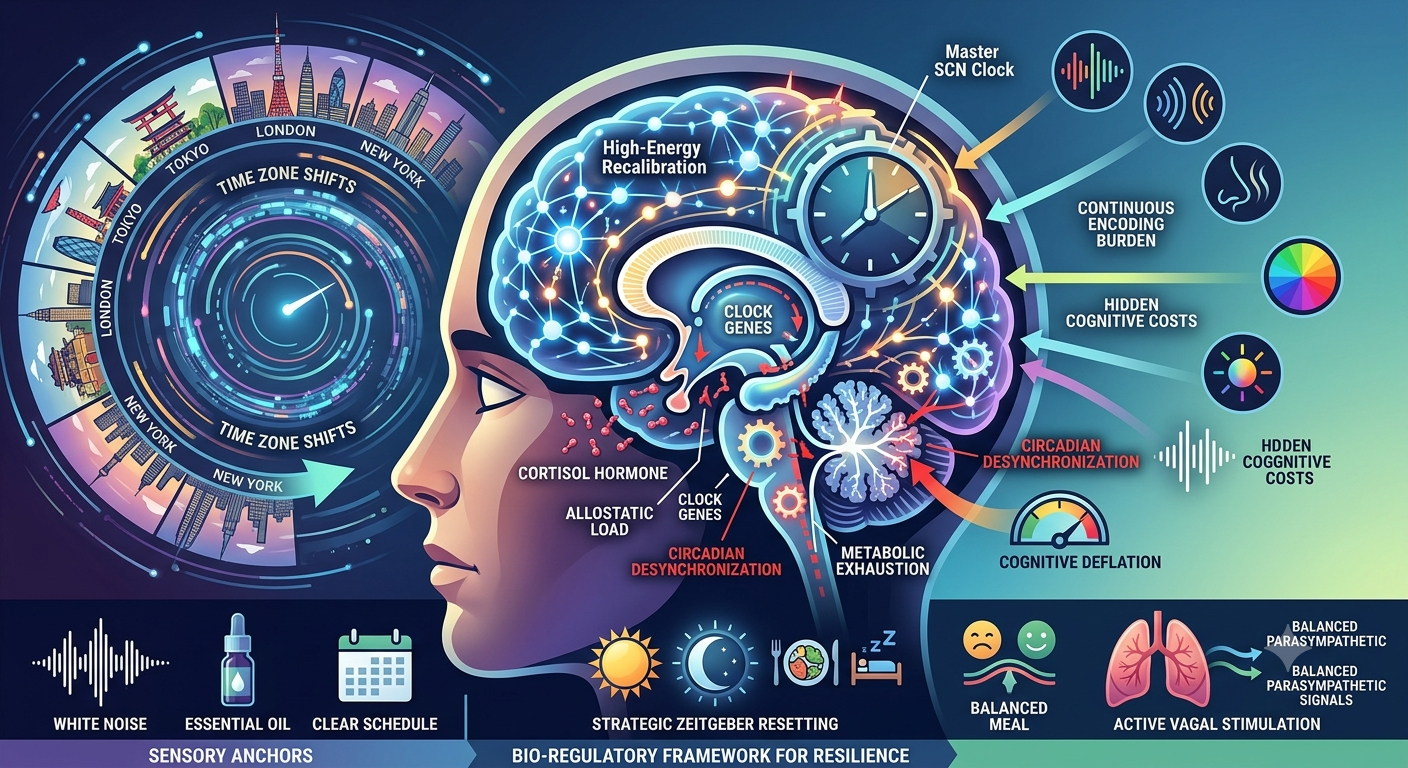
The Mobile Brain: Neuro-Metabolic Adaptation and Circadian Stress in Hyper-Mobile Lifestyles
..
Introduction: The Evolutionary Mismatch of Modern Mobility
For millennia, human physiology thrived under conditions of environmental constancy. The central biological oscillator—specifically the suprachiasmatic nucleus (SCN)—developed in precise synchrony with local geophysical markers. Ancestral populations relied on stable sensory cues: predictable spectral properties of dawn, familiar acoustic signatures, and regional thermal shifts. These environmental anchors allowed the central nervous system to safely down-regulate from hyper-vigilance into restorative parasympathetic states.
In the modern digital era, radical mobility has disrupted this evolutionary paradigm. While geographic independence offers unprecedented professional autonomy, it introduces a subtle physiological friction. The human brain operates fundamentally as a predictive processing mechanism designed for spatial predictability. Frequent transitions across time zones and micro-climates force the organism into continuous, high-energy recalibration.
Allostatic Load in the Unanchored Organism
While homeostasis describes the maintenance of internal stability, hyper-mobile individuals often exist in a state of allostasis—achieving stability through constant physiological adaptation. This ongoing accommodation exacts a measurable biological price: Allostatic Load, the cumulative physiological wear and tear resulting from sustained stress axis activation.
Relocating to a new environment triggers an immediate neuro-spatial assessment. The hippocampus must rapidly encode unfamiliar sensory inputs, inducing a transient surge in systemic cortisol. For the global remote worker, this elevated stress response is no longer an acute survival adaptation; it becomes a metabolic default state driven by frequent logistical and environmental transitions.
The Spatial Mapping Burden: Hidden Cognitive Costs
A major source of internal fatigue stems from the computational strain placed on the spatial navigation system. The brain constructs internal topological representations via specialized hippocampal and entorhinal networks—namely place cells and grid cells. In stable environments, these mental maps become automated, requiring minimal metabolic energy.
Constant relocation disrupts this neural automation:
Continuous Encoding: The brain is forced into perpetual high-fidelity processing to map new geography.
Metabolic Diversion: Constructing and updating spatial maps consumes significant glucose and oxygen.
Cognitive Reserve Depletion: Energy diverted to spatial orientation leaves fewer metabolic resources for complex executive function, creative output, and emotional regulation.
This systemic drain explains the persistent cognitive fatigue or "brain fog" frequently experienced after travel, even in the absence of acute physical exertion.
Circadian Desynchronization and CLOCK Gene Disruption
The most profound physiological cost of frequent travel is circadian disruption. Peripheral clocks embedded in organs like the liver, heart, and digestive tract rely on environmental time-givers (Zeitgebers)—primarily light exposure, meal timing, and physical activity—to maintain alignment with the central master clock in the SCN.
Rapid longitudinal shifts disrupt this harmony, creating circadian desynchronization. For instance, metabolic processes in the liver may lag several time zones behind the light-driven signals received by the brain. This internal misalignment disrupts gene expression, impairs cellular repair mechanisms during sleep, and elevates metabolic stress markers.
A Bio-Regulatory Framework for Mobile Resilience
To mitigate the physiological strain of constant mobility, individuals must establish intentional bio-regulatory practices that provide internal stability despite external fluctuation:
1. Sensory Anchoring
To reduce hippocampal mapping fatigue, introduce portable sensory cues. Utilizing consistent ambient soundscapes, specific olfactory signals, or standardized work routines creates an artificial "sensory anchor." These familiar inputs signal environmental safety to the amygdala, dampening chronic threat-detection mechanisms.
2. Strategic Zeitgeber Resetting
Metabolic timing can be leveraged to realign peripheral clocks quickly. Utilizing targeted fasting during transit and aligning meal schedules immediately with the destination time zone forces liver and gut oscillators to synchronize with the master clock, accelerating recovery from jet lag.
3. Active Vagal Stimulation
Rapid environmental changes frequently trap the nervous system in sympathetic dominance. Deliberate vagal nerve stimulation—such as structured diaphragmatic breathing with extended exhalations—mechanically promotes the shift toward parasympathetic recovery, conserving cellular energy and restoring autonomic balance.
Conclusion
Human freedom in an interconnected world will ultimately be determined not by geographic reach, but by internal biological management. Hyper-mobility represents a real-time experiment in biological adaptability. By understanding the allostatic demands of our environments and implementing intentional physiological anchors, we can preserve systemic resilience wherever we operate.
.
Further Exploration & References
To deepen your understanding of the biological and evolutionary concepts discussed in this article, you may find the following sources insightful:
- Roenneberg, T., & Merrow, M. (2005). Circadian Clocks: Translation Lost. Current Biology, 15(12), R470–R473.
- Schibler, U. (2005). The Daily Patterns of Our Lives. Cell, 121(7), 963–965.
- McEwen, B. S. (1998). Stress, Adaptation, and Disease: Allostasis and Allostatic Load. Annals of the New York Academy of Sciences, 840, 33–44.
- O’Keefe, J., & Nadel, L. (1978). The Hippocampus as a Cognitive Map. Oxford University Press.
- Porges, S. W. (2007). The Polyvagal Perspective. Biological Psychology, 74(2), 116–143.
Support My Research & Stay Connected
If you found this biological deep dive valuable, I invite you to join my growing community of science-driven readers. My work is dedicated to exploring the intersection of neurobiology, psychoanalysis, and physical health to help you reclaim your Biological Sovereignty.
Subscribe to My Substack: Join the “Biological Sovereignty” newsletter for exclusive research updates, in-depth biological protocols, and nuanced insights delivered directly to your inbox. 👉 Join the Community on Substack
Support My Independent Work: If you’d like to fuel my research and help me create more high-quality, evidence-based content, consider supporting me. You can join my paid tiers on 👉 Patreon
Connect Professionally: For professional networking, updates on my academic research, and industry discussions, let’s connect on 👉 LinkedIn
Explore More: You can find a collection of my published work and curated stories here: 👉 Safaa Labib on Digitalmehmet
Thank you for being part of this journey toward mastering your internal ecosystem.
Digital signatures of this article
What are digital signatures and how do I verify them?Content signature:
427ba0cc97498d1b8f68741137bb7eb6MGQCMH9SiCyrz2KgOjO5s++PbFh6EDTBqJ593qD+XUOJiXrzglEtQTVBEvEXphrZHIBCrAIwWjTiunzkFat2ybXLEGHCoDaEgCesy5rsz08ocZEG6n6yKLqmrJ99qOQ5MFcBJjaR
Content Nation Signature
MGUCMDg4eqVCkzWgzFIgUUFw9C2eFHlPpVaL3kubMVc3NJmn4oRAjv7gquWttOeFEY0FLgIxAIxw1WLqTsR4Obdx78RSEwhtXu0AEuVbDZiKWyTzrs96KGnHWnW/CxbNRbBtSqfiiQ==
More signature information
Content signature:
Profile public key (427ba0cc97498d1b8f68741137bb7eb6)