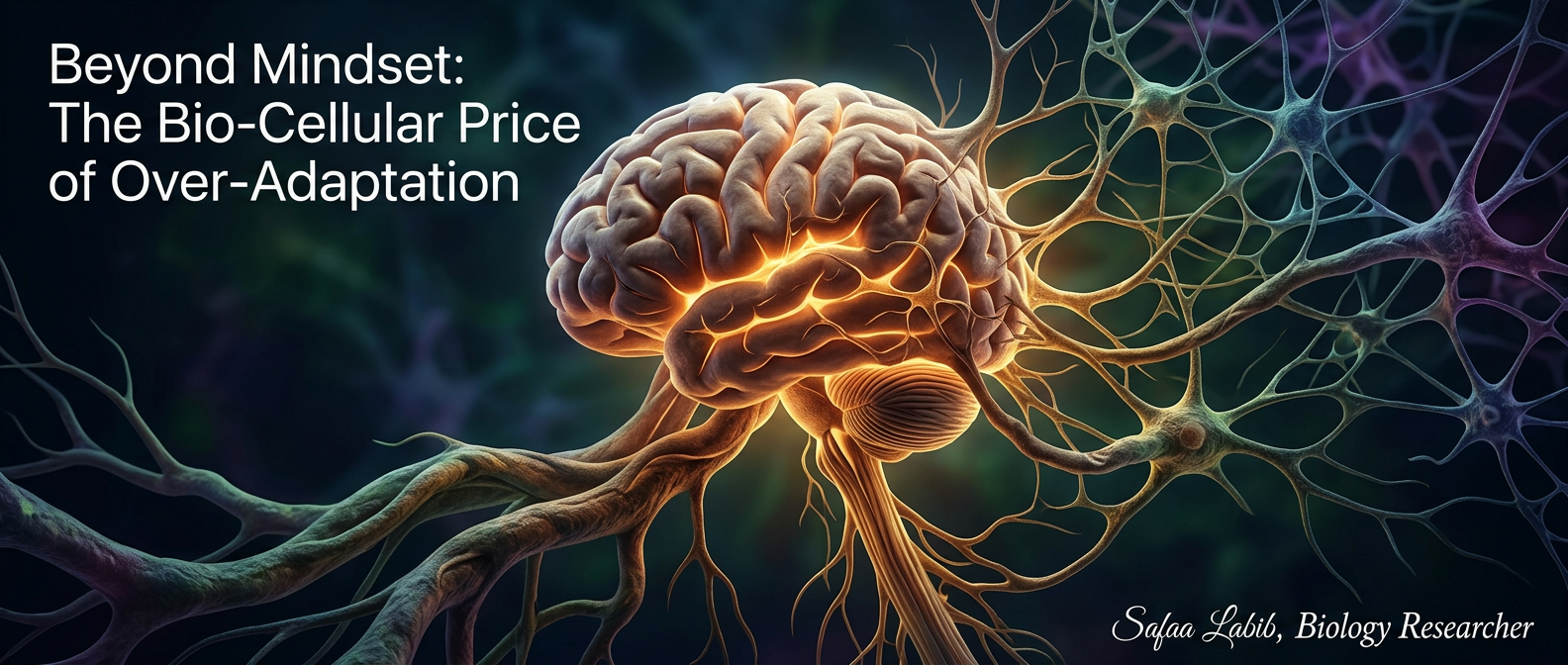
Beyond Mindset: The Bio-Cellular Price of Over-Adaptation and Social Compliance
...
Introduction: Re-evaluating Social Compliance
For decades, mainstream psychology and self-improvement narratives have mischaracterized chronic people-pleasing as a mere psychological weakness, a symptom of low self-esteem, or a lack of personal boundaries. The conventional prescription is deceptively simple: "learn to say no" or "prioritize self-care."
However, viewing this behavior through a strict biological lens reveals a far more complex reality. Chronic over-accommodation is not a moral flaw or a behavioral habit; it is a hardwired, evolutionary defense mechanism designed to secure group belonging and neutralize perceived social threats. When this protective programming becomes a permanent operational state, it exerts a severe physiological toll—rewiring central neural circuits and systematically draining cellular metabolic reserves.
The Neuro-Evolutionary Origins of Social Accommodating
To understand why human beings compulsively accommodate others at their own expense, we must analyze the brain's survival architecture. When the amygdala detects environmental or interpersonal tension, it mobilizes an array of adaptive survival protocols: Fight, Flight, Freeze, or Appease.
While the fight-or-flight response relies on immediate sympathetic activation and rapid catecholamine release, the appeasement strategy functions as a complex, socially mediated defense mechanism. From an evolutionary perspective, when an individual cannot physically overcome a threat or flee from a dominant force, becoming indispensable, highly cooperative, and completely non-threatening ensures survival.
In contemporary human society, immediate physical threats have largely been replaced by psychological and relational stressors: fears of professional ostracization, social isolation, or emotional abandonment. Because the mammalian brain interprets social rejection as an existential threat to survival, it deploys hyper-compliance as a protective biological shield. You do not accommodate because of weak character; your nervous system simply equates agreement with safety.
Cognitive Overload and Prefrontal Energy Depletion
Maintaining a perpetual state of hyper-compliance requires continuous subconscious scanning of the environment. The brain must constantly evaluate vocal shifts, subtle facial expressions, and micro-changes in body language to predict reactions and defuse potential friction before it escalates.
This relentless monitoring is mediated by an overstimulated Reticular Activating System (RAS) working alongside mirror-neuron networks. When conditioned by chronic appeasement strategies, the RAS recalibrates sensory processing—suppressing internal interoceptive signals like fatigue or hunger while prioritizing external environmental data.
Consequently, the Prefrontal Cortex (PFC)—the hub of executive function, emotional regulation, and decision-making—is forced to expend an enormous amount of glucose and oxygen just to sustain this hyper-vigilant posture. The brain is effectively running constant, high-overhead simulations of everyone else's emotional state, leading to profound cognitive exhaustion.
The Cellular Toll: Allostatic Load and Mitochondrial Dysfunction
No organism can sustain a continuous state of high-level threat response without suffering internal wear and tear. In neurobiology, this cumulative physiological drain is defined as Allostatic Load.
Even when an individual outwardly agrees to a request with a smile, the internal suppression of authentic capacity triggers a micro-alarm in the brain. This chronic activation of the Hypothalamic-Pituitary-Adrenal (HPA) axis maintains elevated baseline levels of cortisol. Unlike transient adrenaline bursts that dissipate quickly, sustained systemic cortisol causes insidious damage:
Immune Dysregulation: Dampens effective inflammatory control, predisposing tissues to low-grade systemic inflammation.
Inhibition of Neurogenesis: High cortisol levels reduce neuroplasticity and impair hippocampal function.
Mitochondrial Shutdown: Mitochondria—the cellular powerhouses responsible for generating Adenosine Triphosphate (ATP)—are exquisitely sensitive to persistent stress signaling. Under high allostatic load, mitochondria shift away from maximum energy output and enter a defensive, protective state.
When cellular machinery remains locked in defense mode, ATP production drops sharply. This explains why chronic accommodators experience a deep, systemic fatigue that conventional sleep fails to relieve: the body’s cells are starved of metabolic energy because resources are being diverted to finance a perpetual survival protocol.
The Illusion of Internal Homeostasis
The paradox of chronic appeasement lies in its ability to offer short-term psychological relief. Successfully defusing an immediate conflict triggers a momentary sense of safety, reinforcing the neural pathway.
However, this creates a false sense of homeostasis. It is a costly biological trade-off: external harmony is secured at the expense of internal cellular health. Over time, this chronic neuro-allostatic strain accumulates, leaving the body vulnerable to metabolic exhaustion, systemic inflammation, and complete physiological burnout.
Neural Recalibration: Restoring Biological Autonomy
Because hyper-compliance is rooted in neurobiological survival circuits rather than simple daily habits, resolving it requires a structured approach to down-regulating the nervous system and establishing authentic internal safety.
1. Interrupt the Somatic Alarm Signal
The impulse to instantly yield or accommodate typically begins as a physical sensation—a tightness in the chest or a knot in the gut.
Protocol: Before responding to demands, implement a brief somatic delay. Utilize a physiological sigh (two brief nasal inhales followed by an extended, slow oral exhale). This action stimulates the vagal nerve, lowering heart rate and signaling safety to the amygdala.
2. Re-anchor Attention via Interoception
Appeasement redirects cognitive focus outward. To counteract this, the brain must be re-trained to prioritize internal physiological feedback (Interoception).
Protocol: When a request is made, pause and direct attention inward. Evaluate current metabolic capacity, muscular tension, and energy reserves before offering a response. Treat your internal capacity as an unalterable factor in your decision.
3. Build Tolerance to Boundary Discomfort
Setting a boundary often triggers a spike of anticipatory anxiety as old neural pathways fire off warning signals.
Protocol: Reframe this internal discomfort not as a sign of wrongdoing, but as the inevitable friction of neural rewiring. By remaining grounded through the temporary discomfort of saying "No," you train the prefrontal cortex to establish a new baseline of autonomy and safety.
Conclusion: Protecting Your Metabolic Future
Energy within a biological system is finite. Every single cell operates on a strict metabolic budget, with ATP as its core currency. Continuously spending that currency to manage the emotions and expectations of others leaves your internal cellular ecosystem bankrupt.
True resilience requires protecting your internal biological sovereignty. Boundaries are not acts of interpersonal hostility; they are essential biological mechanisms designed to preserve cellular energy, sustain long-term health, and maintain total systemic integrity.
References
Walker, P. (2013). Complex PTSD: From Surviving to Thriving. Azure Coyote Publishing.
McEwen, B. S. (2000). Allostasis and Allostatic Load: Implications for Neuropsychopharmacology. Neuropsychopharmacology, 22(2), 108–124.
Sapolsky, R. M. (2004). Why Zebras Don’t Get Ulcers. Henry Holt and Co.
Support My Research & Stay Connected
If you found this biological deep dive valuable, I invite you to join my growing community of science-driven readers. My work is dedicated to exploring the intersection of neurobiology, psychoanalysis, and physical health to help you reclaim your Biological Sovereignty.
Subscribe to My Substack: Join the “Biological Sovereignty” newsletter for exclusive research updates, in-depth biological protocols, and nuanced insights delivered directly to your inbox. 👉 Join the Community on Substack
Support My Independent Work: If you’d like to fuel my research and help me create more high-quality, evidence-based content, consider supporting me. You can join my paid tiers on 👉 Patreon,
Connect Professionally: For professional networking, updates on my academic research, and industry discussions, let’s connect on 👉 LinkedIn
Explore More: You can find a collection of my published work and curated stories here: 👉 Safaa Labib on Digitalmehmet
Thank you for being part of this journey toward mastering your internal ecosystem.
Digital signatures of this article
What are digital signatures and how do I verify them?Content signature:
427ba0cc97498d1b8f68741137bb7eb6MGUCMQDRwAtmg0EcjPnaSvw5U+jGyfv3gBeJX+wIWVkJEUqvbS3jxb4Z5iXpZ/8FL/nqGgACMDblEdGf7NqXt4oc+T1GkNKlndRgGMnCVe6aNZKDGFri0z9SgDzZNUUzyMdzuY5JKw==
Content Nation Signature
MGUCMQDhC0ITIXQDMTDgbaJafotdF7FnE2duqLuc4B1Tk2PU7pvoU1vhnfuSjx99GiB18CgCMBRWn22Q1GlAmb/kJcYYsaly0oB4tB/wWXM+ezS9yQ29rWKXtGs0JjtwNvoYYUXzCw==
More signature information
Content signature:
Profile public key (427ba0cc97498d1b8f68741137bb7eb6)