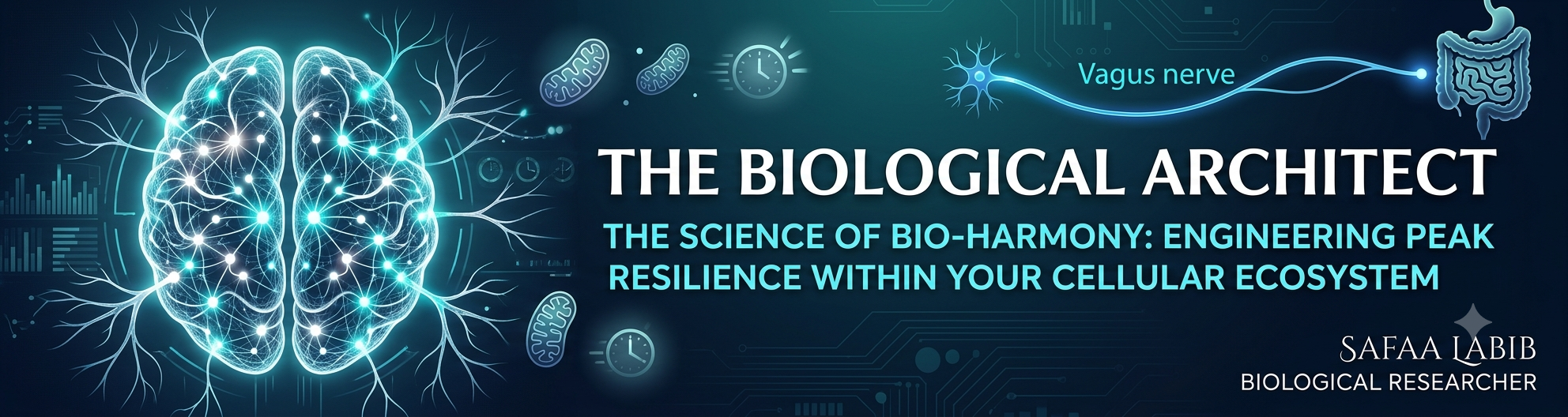
The Science of Bio-Harmony: Engineering Peak Resilience Within Your Cellular Ecosystem
...
Most traditional productivity frameworks treat the human frame as a static machine to be continuously pushed past its threshold. We hear endless talk about "hacking" performance or "grinding" through fatigue. Yet, from a cellular perspective, this mechanistic paradigm is fundamentally flawed. You are not a mechanical engine—you are a dynamic, self-regulating biological ecosystem.
True physiological resilience isn't an abstract ideal; it is a state of Cellular Balance. It occurs when external demands seamlessly match your internal metabolic capacity. When this equilibrium breaks down, we experience more than mental exhaustion—we trigger Cellular Stress.
I. Master Temporal Alignment: The Suprachiasmatic Nucleus (SCN)
The foundation of physiological harmony rests on temporal synchrony. Nestled within your brain's hypothalamus sits the Suprachiasmatic Nucleus (SCN)—the central pacemaker that coordinates roughly 30 trillion secondary clocks in your peripheral tissues.
When you ignore your evolutionary biology—such as exposing your eyes to intense artificial light at midnight or eating during biological night—you induce Circadian Disruption. This is far more severe than simple fatigue. Your liver loses its metabolic rhythm, and the brain's glymphatic system fails to flush out accumulated neurotoxic waste.
Biological Fact: Composed of roughly 20,000 specialized neurons, the SCN governs the metabolic timing of every organ in your body. Interrupting this pathway triggers metabolic desynchronization across all systems.
Aligning your lifestyle with natural light-dark cycles lowers the metabolic cost of alertness, enabling your cells to redirect energy toward repair and autophagy (cellular waste clearance).
II. The Vagal Highway: Regulating the Neuro-Immune System
Physiological balance relies on a physical pathway: the Vagus Nerve. Serving as the main conduit for the parasympathetic nervous system, it acts as a counterweight to sympathetic overactivity. Under persistent stress, your body constantly secretes elevated levels of cortisol and adrenaline.
This ongoing chemical release signals your immune cells to prepare for physical trauma that never arrives, leading to chronic micro-inflammation.
Biological Fact: Approximately 80% of vagal nerve fibers are afferent—meaning they transmit signals from your body up to your brain, rather than the reverse. Your body communicates four times more data to your brain than your brain sends down.
By strengthening vagal tone through intentional deep breathing or targeted cold exposure, you downregulate survival pathways and reactivate executive function in the prefrontal cortex.
III. Mitochondrial Efficiency: The Bio-Energetic Reserve
While many view "burnout" as a purely psychological issue, its root lies in mitochondrial fatigue. Every cognitive task and physical movement depends on Adenosine Triphosphate (ATP) production.
When you push past natural fatigue signals, your mitochondria operate under intense oxidative pressure, releasing reactive oxygen species (ROS) that can damage cellular structures.
Biological Fact: Mitochondria function as environmental radar. When they detect high cellular stress, they trigger a protective "Cellular Danger Response" (CDR), actively dampening high-level focus to conserve energy for basic survival.
Respecting your natural 90-minute ultradian cycles allows you to work alongside your mitochondrial energy capacity rather than draining your bio-energetic reserves.
IV. The Enteric Network: Gut-Brain Intelligence
While rational logic is heavily emphasized, your gut-brain connection operates as a massive data-processing system. The Enteric Nervous System (ENS) contains over 100 million neurons embedded in the gastrointestinal tract.
When your internal environment is balanced, chemical signals between your microbiome and brain travel clearly. Chronic stress or systemic inflammation distorts this communication, resulting in mental fatigue and mood instability.
Listening to "gut instincts" is often your subconscious processing environmental data through your biological pathways faster than conscious thought can register it.
Conclusion: Becoming a Steward of Your Biology
Sustaining internal balance requires active biological stewardship. It means shifting from an "architect of chronic stress" into a cultivator of biological resilience.
By honoring your neurological design and managing your metabolic budget, you transform your relationship with your body from a constant struggle into a cooperative partnership. In a world saturated with digital noise, the ultimate edge isn't how hard you can push—it is how deeply you can align your internal ecosystem.
References & Scientific Foundations
Source 1: [The Master Clock: SCN and the Coordination of Peripheral Rhythms — Nature Reviews Neuroscience.]
Source 2: [Polyvagal Theory: The Neuro-Physiological Foundations of Emotions and Social Regulation — Frontiers in Integrative Neuroscience.]
Source 3: [Mitochondrial Health and the Cellular Danger Response (CDR) — Mitochondrion Journal.]
Source 4: [The Gut-Brain Axis: Microbial Signaling and the Bio-Sovereignty of the Enteric Nervous System — Trends in Neurosciences (2024 Edition).]
Source 5: [Ultradian Rhythms and Cognitive Performance: The Metabolic Cost of Sustained Attention — Annual Review of Psychology.]
Support My Research & Stay Connected
If you found this detailed look at biology helpful, I invite you to join my community of science enthusiasts. My work is dedicated to exploring the intersection of neurobiology, psychoanalysis, and physical health to help you reclaim your Biological Sovereignty.
Subscribe to My Substack: Join the “Biological Sovereignty” newsletter for exclusive research updates, in-depth biological protocols, and nuanced insights delivered directly to your inbox. 👉 Join the Community on Substack
Support My Independent Work: If you’d like to fuel my research and help me create more high-quality, evidence-based content, consider supporting me. You can join my paid tiers on 👉 Patreon
Connect Professionally: For professional networking, updates on my academic research, and industry discussions, let’s connect on 👉 LinkedIn
Explore More: You can find a collection of my published work and curated stories here: 👉 Safaa Labib on Digitalmehmet
Thank you for being part of this journey toward mastering your internal ecosystem.