The Neuro-Metabolic Architecture of Social Consistency: A Biological Breakdown of Human Respect
...
Beyond Moral Virtue: The Energy Economy of Interpersonal Respect
In behavioral science, a practical mental framework known as “The Rock Test” poses a fundamental question: Would your interpersonal conduct shift if the individual standing before you possessed the immense social capital of a high-profile figure? While traditionally examined through a socio-ethical lens, a deeper biological inspection reveals a crucial underlying truth: social inconsistency imposes a heavy bioenergetic toll on the human nervous system.
To understand why human behavior fluctuates across different social ranks, we must explore the bioenergetic constraints of neural architecture and the evolutionary trade-offs that govern cellular survival.
Evolutionary Hierarchies and the HPA Axis
Throughout mammalian evolution, neuro-endocrine systems evolved structured hierarchies to minimize chaotic physical confrontation and preserve finite physiological energy. The Hypothalamic-Pituitary-Adrenal (HPA) axis serves as the primary arbiter of this adaptive strategy, rapidly calculating status to dictate either submissive or dominant neuro-chemical profiles.
However, modern human environments demand interactions with dozens—or hundreds—of unique individuals daily. When the brain is forced to continually recalibrate status and tailor behavior based on fluctuating social power, the HPA axis remains chronically activated. This persistent low-grade stress triggers Allostatic Load—the systemic physiological degradation resulting from prolonged neuro-endocrine adaptation.
Applying a uniform baseline of respect acts as a biological circuit breaker. It signals structural predictability to the central nervous system, effectively dampening unnecessary sympathetic arousal.
The Metabolic Drain of Relational Ambiguity
Despite accounting for only 2% of total body mass, the human brain demands roughly 20% of the body's baseline metabolic energy. Neural architecture relies heavily on structural pattern recognition to minimize energy expenditure.
When individuals practice "Social Morphing"—altering their persona based on perceived social status—they generate substantial Relational Ambiguity. Maintaining distinct personas requires the prefrontal cortex to allocate significant cognitive resources to error-monitoring and impression management.
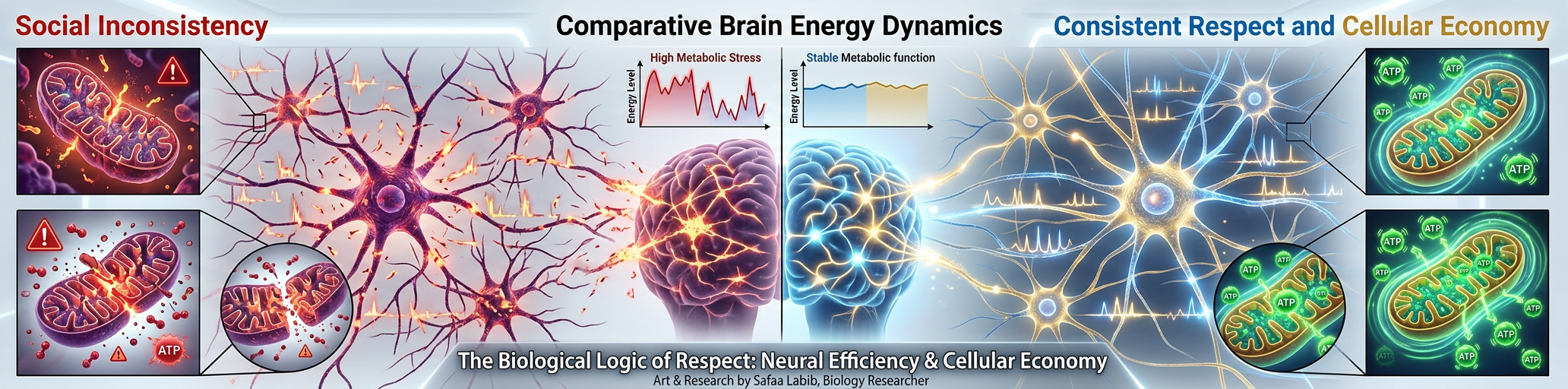
From a neuroenergetic standpoint, inauthenticity causes a continuous drain of Adenosine Triphosphate (ATP). Maintaining behavioral consistency is not merely a social courtesy; it is an efficient neuro-metabolic conservation strategy.
Mirror Neurons and Feedback Loops of Social Tension
The human central nervous system utilizes specialized Mirror Neuron Systems that fire both during the execution and observation of specific behaviors. Treating an individual with consistency and respect engages these neural networks, promoting a stabilized physiological response in the recipient.
Conversely, dismissive or hierarchical behavior triggers a perceived threat response in the counterparty’s biology. Their mirror neurons reflect this subtle hostility, establishing a reciprocal Bio-Feedback Loop of Tension.
This mutual elevation of stress forces the Anterior Cingulate Cortex to engage in constant social error detection—one of the most bioenergetically demanding operations performed by the human brain.
Mitochondrial Psychobiology: Cellular Safety Protocols
Emerging insights in mitochondrial psychobiology demonstrate that cellular mitochondria do more than synthesize ATP; they function as primary environmental and psychological threat sensors. Under conditions of social conflict or status-driven anxiety, signaling pathways alter mitochondrial morphology, shifting them from Energy Production Mode to Cellular Defense Mode.
By establishing consistent interpersonal respect, an individual creates an internal state of Social Safety. This physiological stabilization allows cellular mitochondria to maintain structural integrity, directing metabolic output toward cognitive innovation, cellular repair, and systemic homeostasis rather than active defense signaling.
Default Mode Network (DMN) Integration
The Default Mode Network (DMN) plays a central role in self-referential processing, identity integration, and social cognition. Adopting a single, unvarying standard of respect preserves the structural integrity of the brain’s "Self-Model."
Conversely, constantly toggling between social masks forces the DMN and Anterior Cingulate Cortex to reconcile acute Cognitive Dissonance. Neuroimaging indicates that sustaining inconsistent social personas accelerates cerebral glucose consumption. Behavioral consistency allows the central nervous system to run on an optimized, low-friction energy mode.
Social Thermoregulation and Exhaustion
Human physiology links social connection to thermal regulation—a mechanism studied under Social Baseline Theory. Social rejection or dismissive treatment triggers neural circuits that mimic physical coldness, compelling the recipient’s biology to expend metabolic heat to offset the stress.
This biological "coldness" propagates rapidly through social networks, fostering high-friction, metabolically draining environments that accelerate collective burnout across teams and communities.
Biological Implementation: The 90-Second Reset
To translate these neurobiological insights into daily practice, utilize a structured 90-Second Reset Protocol upon meeting any individual:
Neutralize Power Dynamics: Intentionally frame the interaction through a lens of baseline physiological equality.
Engage Mirror Neurons: Maintain calm eye contact and active presence to signal biological safety.
Stabilize Vocal Tone: Use the same grounded cadence and vocal modulation reserved for a trusted peer.
This protocol stabilizes circulating cortisol levels, regulates dopamine homeostasis, and protects your cellular energy reserves.
Conclusion: Mastering Biological Sovereignty
Biological Sovereignty is achieved by optimizing your internal ecosystem. Universal respect functions as a biological filter. When you extend the same neurological presence to a junior colleague as you would to an industry executive, you practice true Cellular Economy—directing your finite biological ATP toward creation, clarity, and cognitive resilience.
Key Scientific References
Rizzolatti, G., & Craighero, L. (2004). The Mirror-Neuron System. Annual Review of Neuroscience.
Picard, M., & McEwen, B. S. (2018). Psychological Stress and Mitochondria: A Conceptual Framework. Psychosomatic Medicine.
Sapolsky, R. M. (2017). Behave: The Biology of Humans at Our Best and Worst. Penguin Books.
Beckes, L., & Coan, J. A. (2011). Social Baseline Theory: The Role of Social Proximity in Energy Conservation. Perspectives on Psychological Science.
Support My Research & Stay Connected
If you found this biological deep dive valuable, I invite you to join my growing community of science-driven readers. My work is dedicated to exploring the intersection of neurobiology, psychoanalysis, and physical health to help you reclaim your Biological Sovereignty.
Subscribe to My Substack: Join the “Biological Sovereignty” newsletter for exclusive research updates, in-depth biological protocols, and nuanced insights delivered directly to your inbox. 👉 Join the Community on Substack
Support My Independent Work: If you’d like to fuel my research and help me create more high-quality, evidence-based content, consider supporting me. You can join my paid tiers on 👉 Patreon,
Connect Professionally: For professional networking, updates on my academic research, and industry discussions, let’s connect on 👉 LinkedIn
Explore More: You can find a collection of my published work and curated stories here: 👉 Safaa Labib on Digitalmehmet
Thank you for being part of this journey toward mastering your internal ecosystem.
Digital signatures of this article
What are digital signatures and how do I verify them?Content signature:
427ba0cc97498d1b8f68741137bb7eb6MGQCMEXQ1abPPWRaRvnrz0NjhUJv8ehllJ7bjO7ODAN8ad8SJEtCQXuk/LBgX3DuDUQ6EwIwLw87+yMbPX55aoTeJZxVFqtgMP/YGY44cGSuF3vwh/jSfhvYv/2fezn/Ss9mCJaX
Content Nation Signature
MGQCMFPlC/WRQDuW+aKXLFDQyiSAqe81Nb+OjgOMt+rVPdbTUu2zRB+GvWttG0bo5TN8YAIwN7D6TAl5Nq8ZOYIB6kw8G5rTajMtT+9jFrZv7EuuU9UTFIdNdHlvmEUpBU0QGGHt
More signature information
Content signature:
Profile public key (427ba0cc97498d1b8f68741137bb7eb6)