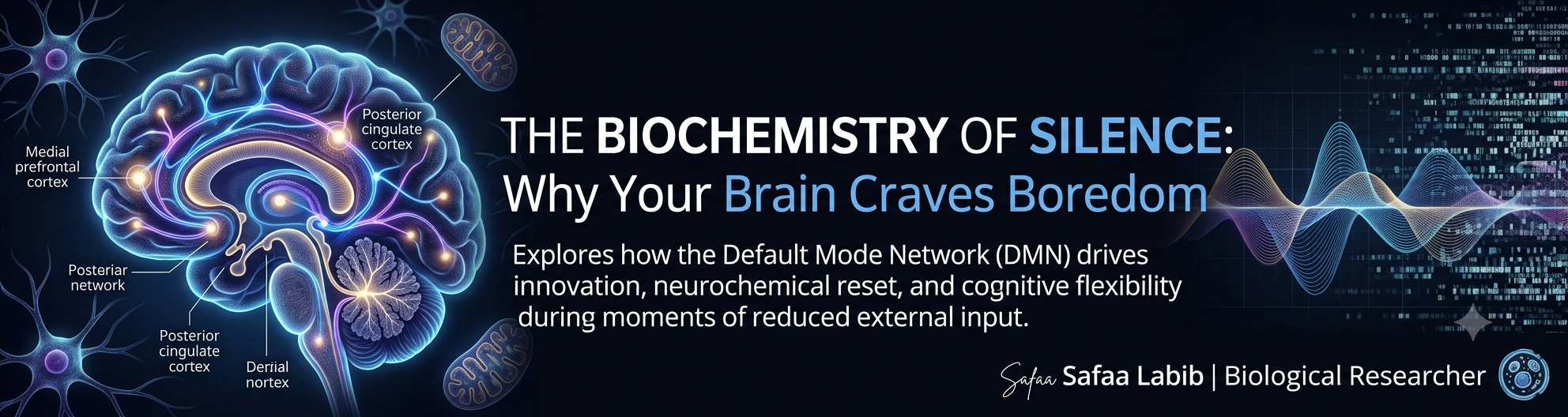
The Neuro-Metabolic Imperative of Unfocused States: How Low-Stimulation Windows Drive Cognitive Breakthroughs
...
The Modern Sensory Surplus: Evolutionary Disconnect and Neural Exhaustion
The digital ecosystem has systematically eliminated cognitive downtime. From a neurobiological standpoint, human neural architecture evolved in low-input environments with frequent intervals of low sensory engagement. Continuous digital consumption keeps the brain locked in a state of high task-positive network activation—the system governing goal-directed, externally focused attention.
Operating under continuous task-positive engagement incurs high metabolic expenditure. The human brain accounts for approximately 20% of systemic energy consumption. Maintaining sustained external focus forces intense glucose and oxygen consumption within executive networks, leaving minimal capacity for internal cognitive consolidation and complex synthesis.
Mapping the Default Mode Network: The Neural Engine of Internal Synthesis
Far from representing a dormant state, low-stimulation periods trigger active functional connectivity within the Default Mode Network (DMN). Anchored primarily within the medial prefrontal cortex and posterior cingulate cortex, the DMN acts as a primary hub for internal processing.
When external inputs decline, the DMN engages in crucial neuro-cognitive functions:
Autobiographical Memory Integration: Linking past experiences with current contextual challenges.
Social Cognitive Processing: Analyzing complex relational dynamics and social frameworks.
Predictive Simulation: Running mental models of potential scenarios in an offline environment.
Unconscious Problem Solving: The Physiology of Subcortical Processing
The sudden emergence of solutions during routine, low-focus activities—often termed incubation—is a well-documented physiological occurrence. When explicit attention disengages, data transfers from executive control centers toward subcortical structures.
This disengagement enables asynchronous neural processing. Within these networks, the brain constructs non-linear associations that are typically filtered out during tight executive focus. Unfocused states allow complex information to reorganize outside the constraints of immediate analytical control.
Context Switching and Metabolic Efficiency
Interrupting quiet intervals with quick digital interactions triggers rapid shifts between the Default Mode Network and the Task-Positive Network. Each transition requires an influx of metabolic resources.
Chronic context switching induces decision fatigue and reduces structural processing efficiency. Depriving the brain of low-input states prevents neurons from transitioning into low-energy consolidation phases, where long-term potentiation and structural knowledge integration occur.
Dopaminergic Sensitivity and Receptor Recalibration
Continuous high-frequency stimulation distorts natural reward signalling. Sustained, small-scale dopamine spikes decrease receptor sensitivity over time, raising the threshold required for cognitive engagement.
Introducing intentional low-input periods acts as a neurochemical recalibration. Lowering baseline dopamine stimulation restores receptor sensitivity, allowing subtle creative insights to register clearly within conscious awareness.
Synaptic Optimization and Structural Consolidation
Information acquisition without consolidation creates cognitive clutter. During extended intervals of reduced sensory input, central nervous system networks engage in selective synaptic pruning—pruning weak or redundant connections while strengthening critical structural pathways.
This cellular maintenance transforms disparate information fragments into structured mental models. Without periods of minimal input, incoming data remains unorganized, limiting its utility for higher-order reasoning.
Resting-State Connectivity and Functional Agility
Functional MRI studies demonstrate that strong resting-state functional connectivity (RSFC)—the baseline communication across distant brain regions during idle states—correlates directly with enhanced cognitive flexibility.
Engaging in low-stimulation environments helps reinforce white matter tracts connecting distinct cortical lobes. This structural integration supports rapid conceptual shifting, enabling smooth transitions between analytical and intuitive reasoning modes.
Practical Protocols for Systemic Downtime
Integrating low-input intervals into daily routines supports optimized neurochemistry:
Zero-Input Intervals: Scheduling daily 15-minute periods completely free from external media or digital consumption.
Unstructured Movement: Taking walks in predictable environments to allow sensory monitoring to shift into automatic mode.
Preserving Transitional Phases: Keeping the early morning waking period and post-task transitions clear of immediate device interaction.
Epigenetic Repair Signals in Stillness
At the cellular level, persistent over-stimulation triggers stress pathways. Conversely, sustained periods of physiological calm downregulate hyper-vigilance mechanisms.
Sustained low-stress states promote gene expression associated with cellular repair, anti-oxidation, and genomic stability. Reducing external threat signaling allows cellular resources to shift from defensive responses toward systemic maintenance and optimization.
Achieving Biological Balance
High-level creative output depends on a structured dynamic balance between intense focus and open-ended processing. Providing the nervous system with necessary quiet intervals ensures the biological infrastructure remains optimized for sustained analytical work.
Scientific References
Buckner, R. L., & DiNicola, L. M. (2019). The organization of the human cerebral cortex estimated from intrinsic functional connectivity. Nature Neuroscience, 22(8), 1275–1282.
Danckert, J. (2023). Out of My Skull: The Psychology of Boredom. Harvard University Press.
Gasper, K., & Middlewood, B. L. (2020). Approaching the boardroom: Benefitting from boredom and relaxation. Journal of Experimental Social Psychology, 89, 103981.
Maniates, H., et al. (2024). Neural Mechanisms of Chronic Over-stimulation: A Neuroimaging Perspective. Frontiers in Human Neuroscience, 18, 54–68.
Picard, M., & McEwen, B. S. (2018). Psychological stress and mitochondria: A conceptual framework. Psychosomatic Medicine, 80(2), 126–140.
Raver, A. L., & Zeidman, P. (2021). The role of the Medial Prefrontal Cortex in the Default Mode Network: A dynamic causal modeling study. Cerebral Cortex, 31(5), 2415–2429.
Velasco, M. J., & Smith, C. R. (2022). Epigenetic signaling and the stillness response: How environmental cues affect gene expression. Journal of Neurogenetics, 36(1), 12–25.
Westgate, E. C. (2020). Why boredom is interesting: Examining the clinical and functional significance of boredom. Current Directions in Psychological Science, 29(1), 33–38.
Support My Research & Stay Connected
If you found this biological deep dive valuable, I invite you to join my growing community of science-driven readers. My work is dedicated to exploring the intersection of neurobiology, psychoanalysis, and physical health to help you reclaim your Biological Sovereignty.
Subscribe to My Substack: Join the “Biological Sovereignty” newsletter for exclusive research updates, in-depth biological protocols, and nuanced insights delivered directly to your inbox. 👉 Join the Community on Substack
Support My Independent Work: If you’d like to fuel my research and help me create more high-quality, evidence-based content, consider supporting me. You can join my paid tiers on 👉 Patreon,
Connect Professionally: For professional networking, updates on my academic research, and industry discussions, let’s connect on 👉 LinkedIn
Explore More: You can find a collection of my published work and curated stories here: 👉 Safaa Labib on Digitalmehmet
Thank you for being part of this journey toward mastering your internal ecosystem.
Digital signatures of this article
What are digital signatures and how do I verify them?Content signature:
427ba0cc97498d1b8f68741137bb7eb6MGUCMQCPQLagWGEaJRw5vBRYKe9i6VnZoTxg8D3jDCnwI2f3dX6DjRFo/mAIijTmj8pPwH0CMFKmAfN0Me34JhUZA+dFGPcvQwl7TOxDW7yNCXRuGRY4963kkcdSjJWdov9ceBSAgg==
Content Nation Signature
MGUCMQDEQq8FH2ICwVJppf2NkX1thDLzh2fA1RZIPb6hAJHiLwfQslZn3mewXAhl5SExgMUCMFblcurq+TiQ1lgaEQmzkv7vm4vxddFXQcuk4ALUnZ1schjhrjjCYvUQqnU6bvrzIw==
More signature information
Content signature:
Profile public key (427ba0cc97498d1b8f68741137bb7eb6)