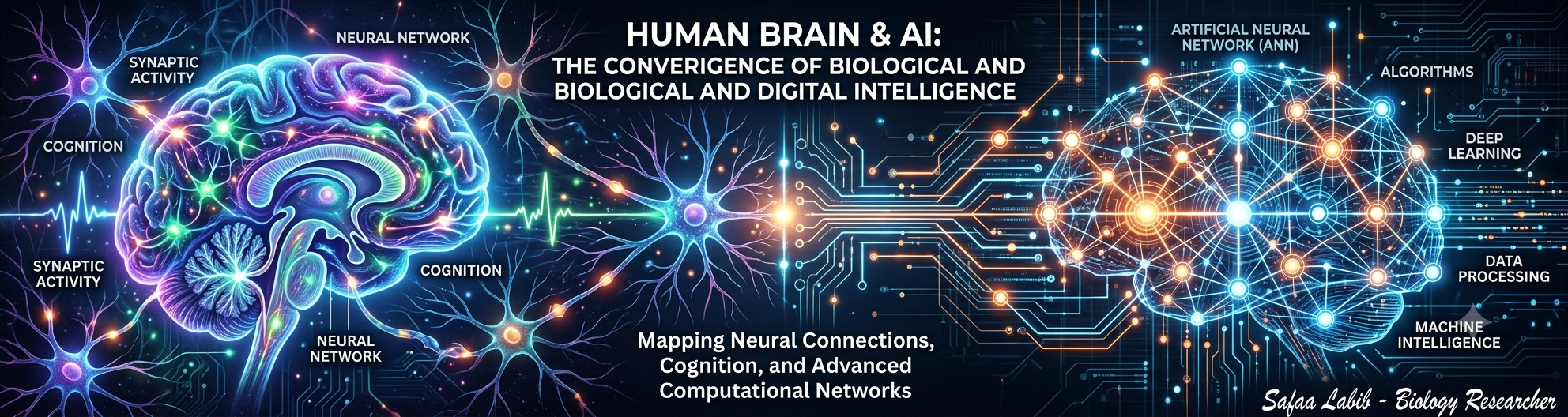
Beyond the Digital Assistant: The Neuro-Cognitive Synergy of Human-AI Scientific Co-Creation
...
For centuries, scientific breakthroughs were viewed through an exclusively anthropocentric lens: the human mind was the sole engine capable of transforming raw data into profound theories. Today, however, we have crossed a pivotal boundary. We no longer simply use computers to process equations; we collaborate with artificial intelligence to synthesize complex concepts.
In contemporary research, generative models are evolving from passive digital calculators into active co-thought partners. Every query a researcher poses initiates a bi-directional feedback loop—a cognitive dialogue where human biological intuition provides direction, and machine statistical speed accelerates ideation.
This transformation is fundamentally altering how scientific ideas are born. To leverage this paradigm shift, we must look beyond operational efficiency, examining the neuro-cognitive mechanics of human-AI collaboration while safeguarding our mental autonomy.
The Bioenergetics of Hypothesis Generation
Formulating a novel scientific hypothesis is among the most metabolically demanding tasks the human brain executes. The prefrontal cortex (PFC)—the seat of executive function—must operate at peak capacity, burning significant amounts of cellular energy (ATP and glucose) to map abstract relationships, identify subtle patterns, and resist innate biases.
When a researcher integrates AI into this process, they establish an Extended Cognitive System. The human brain inherently operates through predictive processing, building mental shortcuts to minimize energetic strain. Deep neural networks, conversely, act as external engines of informational variation.
By evaluating millions of data points and spotting cross-disciplinary links invisible to a single human mind, AI generates alternate conceptual frameworks. When a model proposes an overlooked biological mechanism, it disrupts the researcher's established thinking patterns. This reduces the metabolic friction of initial ideation, allowing the human brain to dedicate its costly cognitive resources to qualitative critique, ethical evaluation, and experimental validation.
Algorithmic Serendipity and the Risk of Mental Anchoring
Historically, major advances often stemmed from serendipity—stumbling upon valuable insights by chance. Yet, human serendipity remains constrained by sensory limits and subjective perspective.
AI introduces what can be described as algorithmic serendipity. Operating within high-dimensional data spaces, an AI model can bridge disconnected disciplines—such as linking a forgotten botanical study with contemporary material science—uncovering hidden structural parallels.
This bio-digital fusion echoes the Extended Mind thesis, which asserts that human cognition can seamlessly merge with external technological tools. Nevertheless, this synergy carries cognitive risks. Because AI platforms output responses with stylistic confidence, researchers risk falling into cognitive anchoring. When our executive filters become overly relaxed, we risk accepting statistical probabilities as absolute truth. To preserve intellectual rigor, researchers must actively apply critical skepticism, ensuring the machine provides the structural framework while the human supplies the conceptual spark.
Visualizing Complex Biological Data
A critical dimension of this partnership lies in data visualization. Intricate biological phenomena—such as subcellular signaling or mitochondrial decay—are often too complex for linear text alone. In this domain, AI visual tools serve as a functional extension of the visual cortex.
Translating abstract mathematical or biological concepts into spatial graphics lowers the cognitive load for both the author and the reader. From a neuro-visual standpoint, well-crafted biological infographics engage the ventral stream of the visual cortex ("what" pathway), facilitating immediate pattern recognition before slower language centers process the text. Using AI as a design proxy enables researchers to overcome graphic limitations and focus strictly on structural fidelity and scientific accuracy.
Preserving Intellectual Sovereignty in an Automated Era
As technology advances, establishing robust cognitive habits becomes essential. While outsourcing data sorting is efficient, outsourcing critical judgment risks neural regression.
Relying entirely on AI to read, synthesize, and evaluate literature can lead to a form of cognitive atrophy, weakening the prefrontal cortex's analytical sharpness. A well-trained human mind must remain the primary filter for reality. AI should be treated as a tool that broadens our perspectives, not an oracle that supersedes our discernment. Maintaining neural sovereignty ensures that human biological intuition and qualitative depth continue to steer discovery.
The Evolution of the Bio-Aware Researcher
Human cognition is inherently plastic. Just as our neural networks adapted to the printing press and the telescope, our modern mental architecture is evolving alongside digital intelligence.
We are transitioning from the age of the isolated thinker toward an era of symbiotic research. Moving forward, major breakthroughs will rarely belong to humans alone or machines in isolation. Instead, they will emerge at the intersection where human biological complexity meets synthetic processing speed. By honoring our physiological intuition and engaging AI as an intellectual mirror, we ensure that as our tools grow more advanced, our scientific wisdom remains deeply human.
References & Further Reading
Bostrom, N. (2014). Superintelligence: Paths, Dangers, Strategies. Oxford University Press.
Clark, A., & Chalmers, D. (1998). The Extended Mind. Analysis, 58(1), 7–19.
Friston, K. (2010). The free-energy principle: a unified brain theory? Nature Reviews Neuroscience, 11(2), 127–138.
Metzinger, T. (2009). The Ego Tunnel: The Science of the Mind and the Myth of the Self. Basic Books.
Support My Research & Stay Connected
If you found this biological deep dive valuable, I invite you to join my growing community of science-driven readers. My work is dedicated to exploring the intersection of neurobiology, psychoanalysis, and physical health to help you reclaim your Biological Sovereignty.
Subscribe to My Substack: Join the “Biological Sovereignty” newsletter for exclusive research updates, in-depth biological protocols, and nuanced insights delivered directly to your inbox. 👉 Join the Community on Substack
Support My Independent Work: If you’d like to fuel my research and help me create more high-quality, evidence-based content, consider supporting me. You can join my paid tiers on 👉 Patreon,
Connect Professionally: For professional networking, updates on my academic research, and industry discussions, let’s connect on 👉 LinkedIn
Explore More: You can find a collection of my published work and curated stories here: 👉 Safaa Labib on Digitalmehmet
Thank you for being part of this journey toward mastering your internal ecosystem.
Digital signatures of this article
What are digital signatures and how do I verify them?Content signature:
427ba0cc97498d1b8f68741137bb7eb6MGYCMQDXYEGE+/SgM/x10NTpBDo8NYGg9vzPFWDnSRieVpSd3N+mYgH41x+4Sp+o4e/R+fMCMQCcSDwpWWADqmnb7BFru52nltU/wbtN/m+KoWeUJq9M0+SIPBA9lHjUdFd7KxUGRe8=
Content Nation Signature
MGUCMQClseM9Ns7sWxlXRrGIamfR01EwsJsAUst9yXfmcLKBavkUJdL+cO7c89AErUvvss4CMCxsu8ebeVD2kWPIV8+osHaaYQrWmLGFsFcgUyPHl5LGkn91vSrn2jc1z44wRrn5Qw==
More signature information
Content signature:
Profile public key (427ba0cc97498d1b8f68741137bb7eb6)