The Internal Desync: Why Your Daily Habits Conflict with Your Biological Timeline
...
The Misunderstood Root of Productivity Failure
Modern performance culture is fixated on spatial efficiency: organizing desks, refining task management software, and building complex daily schedules. Yet, it consistently overlooks a crucial dimension—our internal temporal biology.
When a professional experiences creative blocks, brain fog, or an inability to sustain deep focus, the standard reaction is self-blame. Society labels it a failure of discipline, grit, or motivation.
From a neurobiological perspective, this diagnosis is fundamentally inaccurate. Inability to execute demanding intellectual tasks is rarely an issue of poor character; it is the direct consequence of Chronobiological Desynchronization.
Human physiology does not follow a digital calendar. It relies on an ancient, highly tuned molecular clock built over hundreds of thousands of years. Forcing intense cognitive labor when your nervous system is biologically programmed for cellular maintenance creates severe metabolic friction. High performance requires alignment with our internal timekeeping system.
The Molecular Mechanism: Master Clocks and Peripheral Oscillators
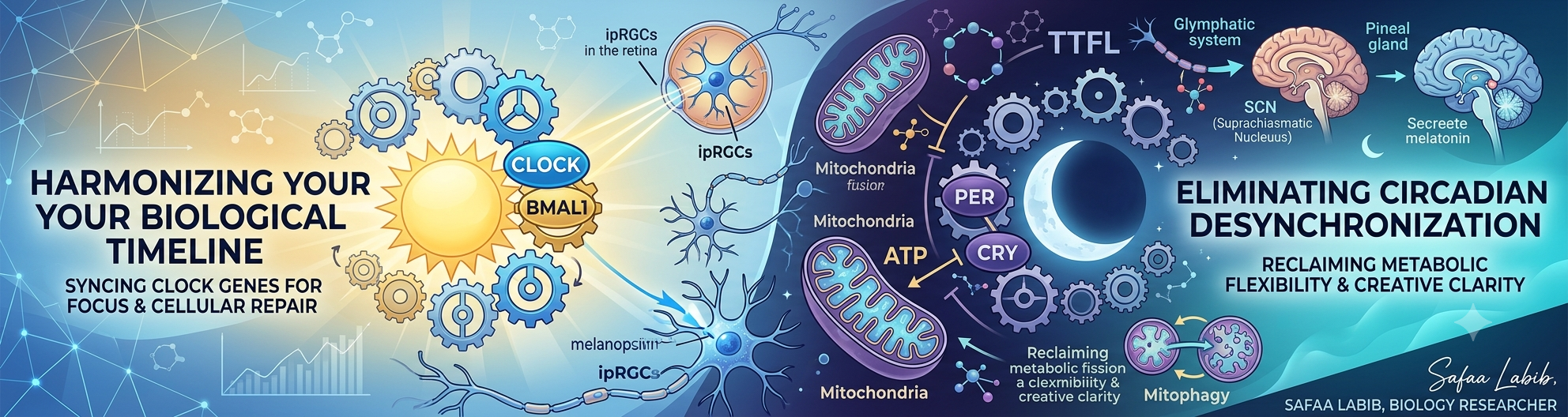
At the center of human temporal regulation is the Suprachiasmatic Nucleus (SCN)—a cluster of roughly 20,000 neurons located in the anterior hypothalamus. Positioned above the optic chiasm, the SCN serves as the master pacemaker. It detects environmental light through specialized, non-visual retinal cells called intrinsically photosensitive Retinal Ganglion Cells (ipRGCs). Packed with the blue-light-sensitive photopigment melanopsin, these cells monitor atmospheric light intensity and send real-time signals to the brain.
However, timekeeping extends beyond the brain. Every peripheral organ and cell contains its own self-sustaining molecular clock, regulated by a Transcription-Translation Negative Feedback Loop (TTFL):
The Core Activation: In the morning, transcription factors CLOCK and BMAL1 bind together to trigger the expression of Period (PER) and Cryptochrome (CRY) genes.
The Negative Feedback: Throughout the day, PER and CRY proteins build up in the cytoplasm. By nightfall, they travel back into the cell nucleus, halting the activity of CLOCK and BMAL1.
The Cycle: This self-regulating cycle lasts approximately 24 hours and governs 10% to 30% of the entire human genome.
When these peripheral and central clocks are aligned, daily metabolic output, hormone release, and neurotransmitter synthesis function smoothly.
The Domino Effect of Modern Circadian Misalignment
Exposing eyes to artificial LED illumination late at night or attempting complex cognitive tasks at midnight disrupts this system:
Hormonal Suppression: Nighttime blue light exposure tricks ipRGCs into signaling the SCN that it is daylight. The brain halts melatonin production from the pineal gland, depriving the body of its most critical antioxidant and sleep signal, while inducing an unseasonable pulse of cortisol.
Mitochondrial Dysfunction: Cellular powerhouses (mitochondria) cycle between fusion (generating maximum ATP energy during daytime) and fission (mitophagy and cleanup during sleep). Desynchronization locks mitochondria in a fragmented state, reducing ATP supply to the brain.
Impaired Waste Clearance (Glymphatic Congestion): Deep sleep shrinks brain astrocytes by nearly 60%, allowing cerebrospinal fluid to clear toxic metabolic debris like amyloid-beta. Disrupting this window leads to acute neuro-inflammation and severe morning brain fog.
Metabolic Exhaustion in the Executive Brain
Although the Prefrontal Cortex (PFC) represents a fraction of total body mass, it consumes more than 20% of metabolic energy. As the command center for emotional control, strategic planning, and focused attention, the PFC demands stable glucose sensitivity—a process directly regulated by peripheral circadian rhythms.
Circadian disruption impairs systemic insulin sensitivity, causing erratic blood glucose fluctuations. When the PFC is starved of its energy source, executive control breaks down:
Cortical Hijacking: An energy-depleted PFC loses top-down control over the amygdala and nucleus accumbens.
Survival Mode Activation: The brain shifts from strategic thinking to short-term survival instincts.
Procrastination Traps: Complex goals feel threatening, causing the brain to seek quick, low-effort dopamine hits from social media and immediate distractions.
Restoring Biological Synchrony: Evidence-Based Protocols
Optimal mental performance is a physiological state. Re-anchoring internal molecular clocks requires deliberate environmental cues (Zeitgebers):
A. Morning Photic Calibration
Expose eyes to natural outdoor sunlight for 10–15 minutes within an hour of waking. Direct sunlight provides an intensity of 10,000 to 100,000 lux—sufficient to trigger the morning cortisol surge, clear lingering melatonin, and initiate the 16-hour sleep timer. Avoid high-intensity blue light after 9:30 PM.
B. Time-Restricted Feeding
Peripheral organs calibrate their clocks through food intake rather than light. Late-night meals desynchronize liver and gut clocks from the central SCN. Restrict eating to a consistent daily window and end all caloric intake at least 3 hours before sleep.
C. Chrono-Optimized Workflows
Align cognitive demands with natural physiological shifts:
Morning (Rising Cortisol): High-demand analytical thinking and complex problem-solving.
Late Afternoon: Physical activity, tactical execution, and spatial tasks.
Evening: Divergent creative thinking, as executive inhibition naturally lowers.
Conclusion: Achieving Biological Sovereignty
Modern environments treat human biology as an artificial machine meant to operate continuously under artificial light. Achieving sustainable cognitive performance requires working with our biology rather than against it.
By protecting your circadian rhythms and honoring the molecular mechanisms of your CLOCK genes, deep focus becomes a natural output of a synchronized system. True autonomy begins by aligning daily habits with our internal biological design.
References
Czeisler, C. A., & Gooley, J. J. (2024). Photic Regulation of the Human Circadian Pacemaker. Journal of Biological Rhythms.
Nedeltcheva, A. V., & Scheer, F. A. (2023). Metabolic Effects of Circadian Misalignment. Current Opinion in Endocrinology & Diabetes.
Nedergaard, M., & Goldman, S. A. (2022). The Glymphatic System and Astrocytic Rhythms. Science.
Takahashi, J. S. (2023). The Transcriptional Architecture of the Mammalian Circadian Clock. Nature Reviews Genetics.
If you found this biological deep dive valuable, I invite you to join my growing community of science-driven readers. My work is dedicated to exploring the intersection of neurobiology, psychoanalysis, and physical health to help you reclaim your Biological Sovereignty.
Subscribe to My Substack: Join the “Biological Sovereignty” newsletter for exclusive research updates, in-depth biological protocols, and nuanced insights delivered directly to your inbox. 👉 Join the Community on Substack
Support My Independent Work: If you’d like to fuel my research and help me create more high-quality, evidence-based content, consider supporting me. You can join my paid tiers on 👉 Patreon,
Connect Professionally: For professional networking, updates on my academic research, and industry discussions, let’s connect on 👉 LinkedIn
Explore More: You can find a collection of my published work and curated stories here: 👉 Safaa Labib on Digitalmehmet
Thank you for being part of this journey toward mastering your internal ecosystem.
Digital signatures of this article
What are digital signatures and how do I verify them?Content signature:
427ba0cc97498d1b8f68741137bb7eb6MGQCMAr7ePKuYNI1hWH8dA3ynXT6Y5M/8D3TRvzKUMynHixsMrYfmIcWM2hNbc6FwPdhsQIwKlyJNRedB0euS/OZZMWqw+6TTpu9Ui2HzaB9UfqAAGe3LqqIKiuPzoYGjYdXksoM
Content Nation Signature
MGQCMF2A9VlkyVRfxqeVmT9Q5mRt4ucm7oBYDVYIOVqWNbCekRm6Tlbn+QWAN/45kCPqDwIwBx6f7KNqzs4GAvSQNq+/6rz4YnIJ0xWCp/Q6V1wfph1n2Zn9X81uOCHh0ujPqbPT
More signature information
Content signature:
Profile public key (427ba0cc97498d1b8f68741137bb7eb6)