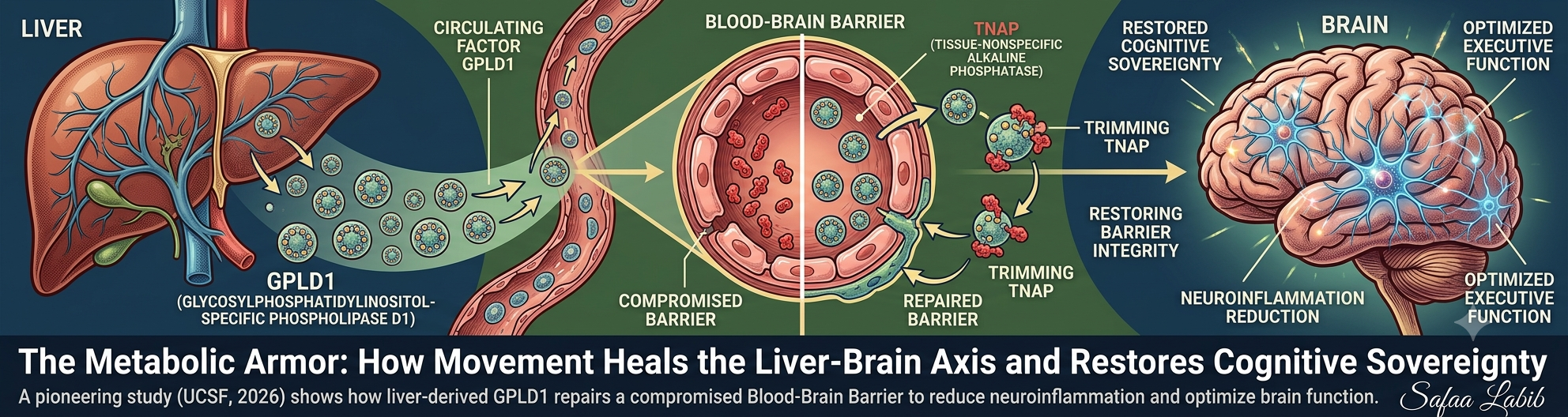
The Metabolic Armor: How Movement Heals the Liver-Brain Axis and Restores Cognitive Sovereignty
...
We often treat our minds as isolated rulers sitting at the top of the body, managing everything through pure willpower. When we find ourselves trapped in the exhausting loops of burnout, perfectionism, or information fatigue, our first instinct is to fix it through psychological means alone—telling ourselves to relax, meditate, or force a positive mindset.
Yet, your mind is never an isolated island. It operates within a deeply integrated biochemical ecosystem.
When psychological stress burns steadily beneath the surface, your nervous system slips into what feels like a continuous metabolic overdraft. A pivotal peer-reviewed study published by researchers at the University of California, San Francisco (UCSF) illuminates an extraordinary whole-body rescue mechanism that fundamentally shifts how we understand cognitive resilience.
The Invisible Breach: When the Brain's Fortress Wears Down
At the perimeter of your central nervous system sits a highly selective gatekeeper: the Blood-Brain Barrier (BBB). This sophisticated web of micro-vessels permits essential nutrients to enter while blocking circulating toxins, pathogens, and systemic inflammation from reaching delicate neural tissue. It remains the ultimate protector of your daily mental clarity.
However, prolonged psychological pressure—such as the relentless anxiety tied to modern productivity demands—floods the system with cortisol and inflammatory signaling molecules. This persistent environmental stress forces the brain away from high-level cognitive execution and into a survival-driven defensive posture.
As documented in the UCSF findings, sustained metabolic strain causes the cells that compose this protective barrier to accumulate a damaging enzyme known as TNAP (Tissue-Nonspecific Alkaline Phosphatase).
When TNAP levels rise abnormally, the structural integrity of the barrier begins to fail. Microscopic gaps form, allowing unwanted circulating compounds to slip into brain tissue. This triggers localized neuroinflammation, manifests as stubborn brain fog, and accelerates cognitive wear. This physiological breakdown aligns with archival data from the National Center for Biotechnology Information (NCBI), which emphasizes that increased blood-brain barrier permeability acts as a primary catalyst for neurodegenerative decline. You aren’t merely tired; your physical shield has developed fractures.
Enter the Liver: The Body’s Molecular Repair Crew
For years, neuroscientists observed that physical activity rejuvenates cognitive function and subdues systemic inflammation, yet a puzzling paradox remained: many of the protective compounds triggered by muscle contraction originate in peripheral organs and are far too large to physically cross the blood-brain barrier themselves.
The UCSF research breakthrough resolved this mystery by mapping out the direct mechanics of the Liver-Brain Axis.
When you engage in deliberate physical movement, your liver activates, synthesizing a specialized restorative enzyme called GPLD1 (Glycosylphosphatidylinositol-specific phospholipase D1). Although GPLD1 does not need to cross into the brain itself, its role is equally vital. It functions as a circulating molecular scaffold crew that travels directly to the cerebral vascular borders.
Once on site, GPLD1 targets the compromised vessels, acting much like biological shears—it precisely trims and clears away the destructive TNAP proteins accumulating on the barrier cells. By stripping away this harmful accumulation, the liver-derived enzyme effectively patches the microscopic gaps in the barrier, subdues local inflammation, and restores swift executive function and memory consolidation.
This builds gracefully upon earlier foundational research published in Science, which first demonstrated that circulating liver factors transfer the systemic benefits of exercise directly to the aging brain, confirming that whole-body communication is the true cornerstone of cognitive vitality.
Reclaiming Your Sovereignty: The Movement Protocol
This biological revelation transforms our approach to mental fatigue. Overcoming a cycle of cognitive exhaustion or mental rigidity cannot be achieved solely by commanding your mind to cooperate; it requires mobilizing your peripheral organs to defend your neural architecture.
To activate this liver-brain pathway and protect your metabolic baseline, you can leverage simple, full-body bio-hacks:
Trigger the GPLD1 Surge: When caught in a mental bottleneck or afternoon slowdown, avoid punishing your prefrontal cortex by sitting longer. Stand up and complete 5 to 10 minutes of moderate, purposeful movement—such as brisk walking, dynamic stretching, or light calisthenics—to prompt your liver to release its protective enzymes toward your cranial circulation.
Lower the Metabolic Tax: Recognize that biology explains your sensations of fog and exhaustion, but conscious agency guides your response. Use self-kindness to drop acute cortisol levels, giving the liver-brain axis the physiological baseline it needs to repair.
Protect the Foundation: Your nervous system relies entirely on steady systemic homeostasis. Prioritize deep rest and high-quality nutrition to supply your liver and vascular network with the raw materials required to maintain robust tissue barriers.
A Whole-Body Paradigm
The UCSF findings offer a refreshing reminder of a principle traditional brain research often overlooks: your physical body is an active, indispensable participant in your mental resilience. You cannot simply think your way out of a compromised neural barrier, but you can move your way into structural renewal.
By understanding the exquisite chemical dialogue happening between your liver and your brain, you step away from endless frustration and into a state of authentic, biologically grounded sovereignty.
Scientific Foundations & References
Bieri, G., Pratt, K., Fuseya, Y., Aghayev, T., & Villeda, S. (2026). Scientists find a mechanism for how exercise protects the brain. University of California — San Francisco (UCSF) Bakar Aging Research Institute. Published in Cell.
- Horowitz, A. M., Fan, X., Bieri, G., Smith, L. K., & Villeda, S. A. (2020). Blood-borne liver factors transfer the regenerative effects of exercise and restore cognitive function in the aging brain. Science, 369(6500), 167–173.
- Sweeney, M. D., Sagare, A. P., & Zlokovic, B. V. (2018). Blood-brain barrier breakdown in Alzheimer’s disease and other neurodegenerative disorders. Nature Reviews Neurology, 14(3), 133–150.
- Yamazaki, Y., & Kanekiyo, T. (2017). Blood-brain barrier dysfunction and the pathogenesis of Alzheimer’s disease. Frontiers in Aging Neuroscience, 9, 11–23. Archived in National Center for Biotechnology Information (NCBI / PubMed).
Support My Research & Stay Connected
If you found this biological deep dive valuable, I invite you to join my growing community of science-driven readers. My work is dedicated to exploring the intersection of neurobiology, psychoanalysis, and physical health to help you reclaim your Biological Sovereignty.
Subscribe to My Substack: Join the “Biological Sovereignty” newsletter for exclusive research updates, in-depth biological protocols, and nuanced insights delivered directly to your inbox. 👉 Join the Community on Substack
Support My Independent Work: If you’d like to fuel my research and help me create more high-quality, evidence-based content, consider supporting me. You can join my paid tiers on 👉 Patreon,
Connect Professionally: For professional networking, updates on my academic research, and industry discussions, let’s connect on 👉 LinkedIn
Explore More: You can find a collection of my published work and curated stories here: 👉 Safaa Labib on Digitalmehmet
Thank you for being part of this journey toward mastering your internal ecosystem.
Digital signatures of this article
What are digital signatures and how do I verify them?Content signature:
427ba0cc97498d1b8f68741137bb7eb6MGUCMFgSzbnN1bDemOCwkZuCWTR9odWqYqEk6+zRWNYAi53FhGwxu400ulahY8Nk7ctsaQIxAOwgw917neIRxnFSam799QJQOqBdoAQShrESQJBtlE6+VZ3wjnaabq3quKtyLN9+LQ==
Content Nation Signature
MGUCMD8RMt2jJ+QPj/zD/brs7I1UQs0WLXI+YdGEWMP0I1Y/a7+3jRyPG9xw3Uhv0gP0NgIxAPsIPdr2/1Yj/LUVBxl7r0/7Uq5GJRQHAbJ2VifhjBeZry/6q7PaT34pPSeRngWuxw==
More signature information
Content signature:
Profile public key (427ba0cc97498d1b8f68741137bb7eb6)