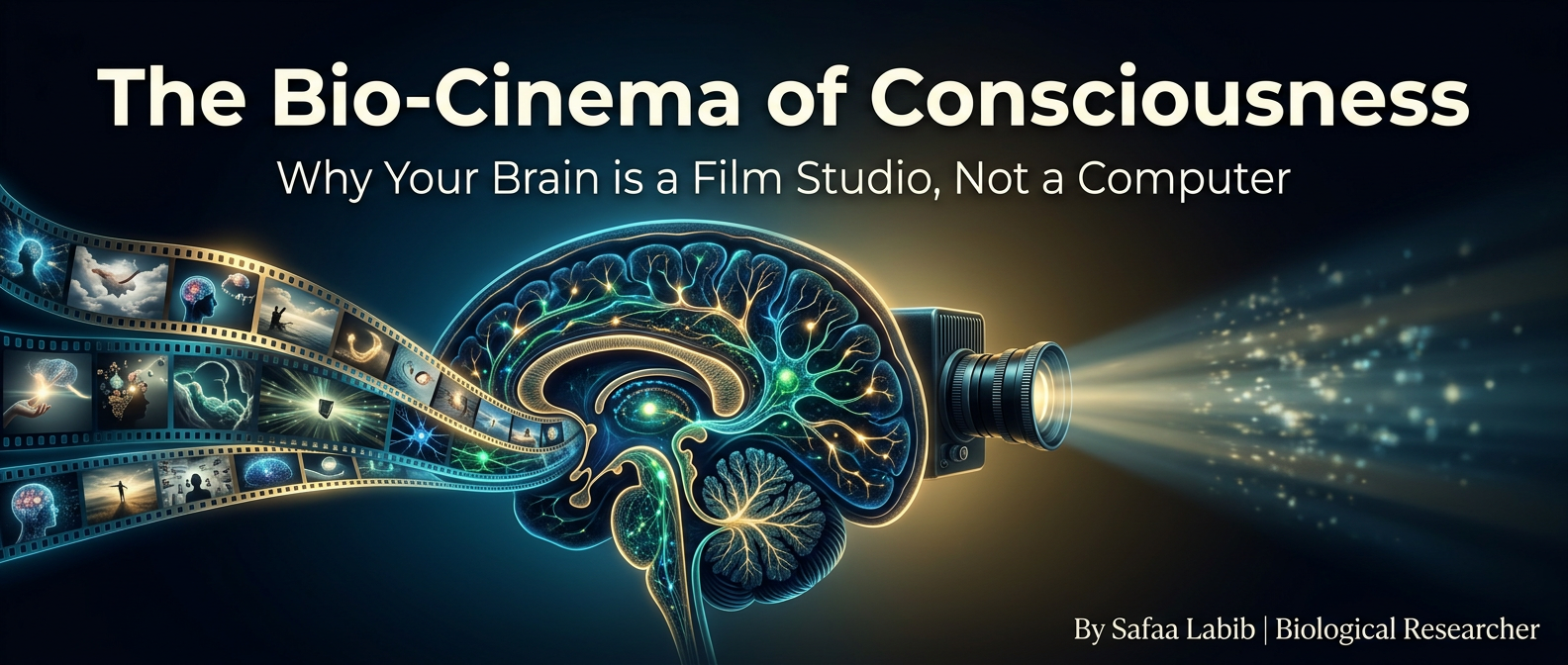
The Bio-Cinema of Consciousness: Why Your Brain is a Film Studio, Not a Computer
...
For decades, we have been sold a cold, mechanical lie: that the human brain is a supercomputer. We talk about "processing power," "hard drives of memory," and "software updates" for our daily habits. But if you stop for a moment and observe the texture of your internal life, you will realize that this metaphor is deeply and fundamentally wrong.
Computers don’t feel the golden hour light hitting your face, nor do they feel the heavy, knotting weight of anxiety in their chest. They don’t weave narratives out of chaos. As the pioneer psychologist William James once suggested in his masterwork, The Principles of Psychology:
"Our experience is essentially what we agree to attend to—a creative act of selection rather than a passive recording of events."
Your mind isn’t a digital processor; it is a living, breathing Film Studio. Every second, your brain acts as a director, a scriptwriter, and a cinematographer, taking the raw, chaotic sensory data of the world and editing it into a continuous, cinematic experience. It adds a soundtrack to your memories, adjusts the "lighting" of your mood based on your nervous system, and dictates the pacing of your reality.
The most profound realization of the 21st century is not that we are machines, but that we are artists of our own perception. We don’t just experience the world; we project it.
The Biological Crew: Who is Running the Show?
If your mind is a film studio, then your brain is the most complex crew ever assembled. But unlike a Hollywood set, these departments don’t work from a static script—they are constantly improvising based on your biological state:
The Director (Prefrontal Cortex - PFC): Standing at the helm, the PFC is responsible for the "big picture," the narrative arc, and the logic that attempts to make sense of the chaos. When you are well-rested and regulated, the Director is calm, focused, and capable of overseeing a masterpiece.
The Cinematographer (Amygdala): Sitting in the editing booth with its hand hovering over the "Color Grade" dial is your Amygdala. It doesn’t care about logic; it cares about survival. When it senses a threat—or even just the subtle, lingering hum of chronic stress—it instantly changes the lighting, filtering your reality through high-contrast, dark, and saturated tones of "danger" and "urgency." This is why, under the fog of burnout, the world feels bleak and overwhelming.
The Archive (Hippocampus): Acting as the studio's film library, the Hippocampus stores every past frame. It actively pulls scenes from the past and splices them directly into your current reality.
The Power Supply (Nervous System): This is the studio’s energy grid. When it is dysregulated, the studio lights flicker, the film glitches, and the Director loses control.
The Montage of Memory: How We Edit Our Own Reality
In cinema, the "montage" is where the magic happens—it’s the art of splicing together disparate moments to create a new meaning. Your brain is a master of this craft, but it often operates on autopilot, using old, dusty footage to tell the story of your future.
Think about how you experience a stressful moment: you aren’t just reacting to what is happening right now. Your brain’s editing room is working at lightning speed, pulling a scene from five years ago, mixing in a fear from yesterday, and layering it over the current frame. This is the Montage Effect. When we are stuck in a cycle of brain fog or anxiety, we are essentially stuck in a repetitive loop of the same old scenes.
But here is the breakthrough: Neurons that fire together, wire together. Every time you consciously reframe a thought or regulate your nervous system, you are actively editing the film. You are deleting a scene, changing the pacing, and inserting new, high-definition footage of presence and calm.
As Bruce Lipton illustrates in The Biology of Belief:
"Our perceptions act as a signal that can actively regulate our biological expression, proving that we are the active directors of our own physiological state."
Bio-Direction: Taking Control of the Camera
Taking control of the camera isn’t about sheer willpower; it’s about Bio-Direction.
When you use sensory grounding techniques or breathwork to down-regulate your system, you are "adjusting the lighting," signaling to your Cinematographer that the studio is secure. When you engage in intentional focus exercises, you are "directing the pacing," choosing a long, steady shot of the present moment.
By stabilizing your physiology, you ensure that the Director (your Prefrontal Cortex) has the clear, high-definition signal it needs to steer the narrative, rather than being forced to improvise with shaky, low-quality footage.
(For those looking to go deeper into the neuroscience of rewiring these biological patterns, I highly recommend exploring Gary L. Fretwell's blueprint in "The Identity Ghost").
Conclusion: You Are the Critic and the Director
We often go through life believing we are merely the audience, sitting in a dark theater, passively watching the film of our own lives unfold. But the truth is far more empowering: You are not the audience. You are the Critic, the Director, and the Star all at once.
The future of your consciousness is a film you are co-creating with your biology every single moment. If the footage was poor, it wasn’t a failure of your character; it was a call to service your equipment.
Your brain will continue to project a narrative no matter what. But you have the power to decide which scenes to keep, which to cut, and most importantly... how to light the frame.
The cameras are rolling, and the stage is set. What kind of story are you going to direct tomorrow?
📚 Suggested Further Reading:
The Identity Ghost: Designing a Life of Purpose through Neuroscience – Gary L. Fretwell
The Principles of Psychology – William James
The Biology of Belief – Bruce Lipton
Support My Research & Stay Connected
If you found this detailed look at biology helpful, I invite you to join my community of science enthusiasts. My work is dedicated to exploring the intersection of neurobiology, psychoanalysis, and physical health to help you reclaim your Biological Sovereignty.
Subscribe to My Substack: Join the “Biological Sovereignty” newsletter for exclusive research updates, in-depth biological protocols, and nuanced insights delivered directly to your inbox. 👉 Join the Community on Substack
Support My Independent Work: If you’d like to fuel my research and help me create more high-quality, evidence-based content, consider supporting me. You can join my paid tiers on 👉 Patreon
Connect Professionally: For professional networking, updates on my academic research, and industry discussions, let’s connect on 👉 LinkedIn
Explore More: You can find a collection of my published work and curated stories here: 👉 Safaa Labib on Digitalmehmet
Thank you for being part of this journey toward mastering your internal ecosystem.
Digital signatures of this article
What are digital signatures and how do I verify them?Content signature:
427ba0cc97498d1b8f68741137bb7eb6MGQCMCqcVCqZQUIN7uT9WA1R8QkJp0gUgSy388O8W18Ku6nTzVcxD3HLX5tjQHrITEqwYgIwQ7+91CDwb665axT/XhZiZ+UBQCpGvW8Ve9X2xS5EFwQrLbotMfWa2fKaR1J9Z8ZN
Content Nation Signature
MGUCMCn63jPkaiBl1z1F7uFQ9Cqtf+c5xHffezkipf3HgHcB1oEnYse1IhA7pQHUuWxs3wIxANd6RzHCKp0By+8EMTbDyspND84m1bnx9cupjpAHDdGFE2wKN8r/OFjps547KsyR5g==
More signature information
Content signature:
Profile public key (427ba0cc97498d1b8f68741137bb7eb6)